Peptide Release Qc Screening Services Bio-synthesis
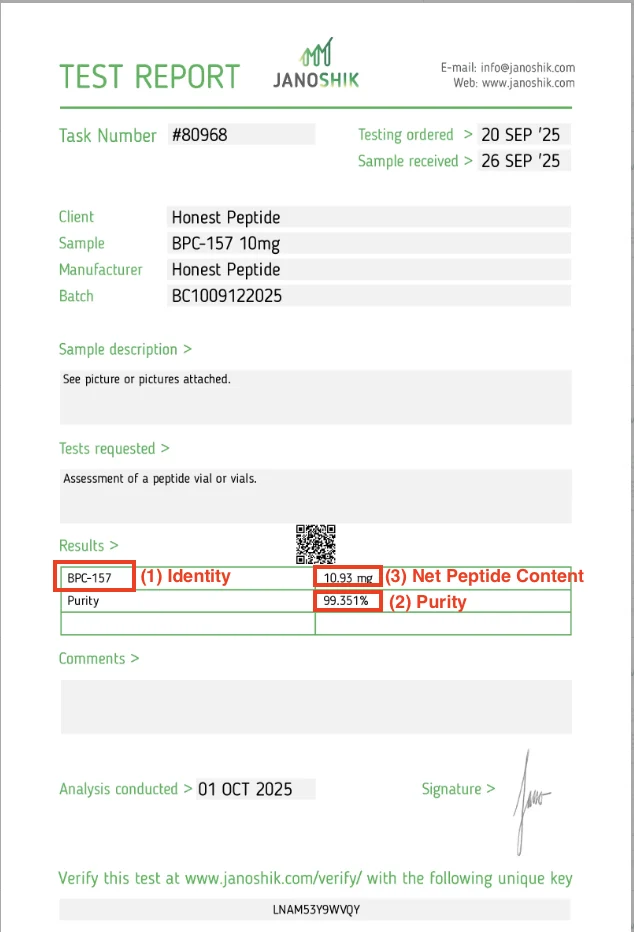
Peptide Launch Qc Testing Services Bio-synthesis Identification verification validates the particular secretagogue being examined. Peptides like BPC-157 and TB-500 utilized for injury healing applications need to obtain full verification. Identity verification is essential because substitution with various substances would fundamentally alter the research technique. The screening procedure involves certain steps to ensure precise results and appropriate sample handling. For these high-stakes circumstances, the price of testing is insignificant compared to possible repercussions of utilizing unverified products. For researchers complying with procedures from sources like the BPC-157 and TB-500 stacking overview, confirmed product quality guarantees the method gets a reasonable examination. Peptide pureness screening stays one of one of the most crucial devices scientists make use of to evaluate study substance high quality. With approaches such as HPLC and mass spectrometry, scientists can much better recognize peptide composition, verify item identity, and Purity Verification evaluation supplier high quality criteria. When combined with Certificates of Analysis and clear documentation, purity screening assists sustain educated sourcing choices and long-lasting research consistency. When examining a peptide distributors listing, researchers need to focus on suppliers that provide detailed logical information. Commercial intent for peptides often causes a market filled with resellers that may not verify the stability of their supply throughout transportation.
- You have actually purchased peptides from what felt like a reputable vendor.
- Mass spectrometry (MS) validates peptide identity by gauging molecular weight.
- From example prep work to final reporting, we ensure every peptide satisfies extensive high quality standards, equipping your research study and restorative growths with confidence.
Weight Monitoring Peptides
As a matter of fact, a laboratory offering peptide screening should provide data satisfying the rigorous logical assumptions of agencies like FDA and EMA [4] By utilizing a certified third-party laboratory, peptide makers or researchers make sure an unbiased and professionally recorded evaluation of high quality, which is precisely what assessors seek. Furthermore, ongoing independent screening sustains compliance in batch release and quality assurance. For scientists, acquiring validated peptides isn't simply a formality-- it's the structure of trustworthy experiments and research study reproducibility. A 95% pureness implies that out of every 100 "books" in your batch, 95 are ideal duplicates and 5 have some kind of mistake. This overview breaks down what pureness actually indicates in peptide chemistry, how it's determined, what the pollutants are, and how to read the documents that shows a peptide is what it declares to be. If you've ever before browsed a peptide catalog, you have actually seen purity numbers anywhere. These numbers get sprayed so commonly that it's simple to gloss over them-- just another spec on a product page. Chameleon Peptides sells research substances specifically for lab and analytical functions.What device is utilized to evaluate peptide purity?
Peptide purity is regularly identified by HPLC (high performance liquid chromatography). This method enables separation and family member metrology of each peptide synthesized. If coupled to a mass spectrometer (MS), this offers molecular mass/ identification info of the target peptide and coming with impurities.
What Logical Techniques Were Utilized?
HPLC is among one of the most commonly used techniques in peptide purity testing. If you see multiple huge tops of similar elevation, you're checking out either a low-purity sample or a mix. If the primary height has a noticeable "shoulder"-- a bump on one side-- that often shows a carefully related pollutant (like a removal peptide) that the column couldn't totally fix. The peptide is travelled through a basic filtration step (often gel filtering or a quick reversed-phase cleanup) to get rid of salts, small-molecule byproducts, and scavengers from the bosom action.Lead Validated (silver)
One core technique is High-Performance Fluid Chromatography (HPLC), the gold standard for assessing peptide pureness. HPLC separates peptide combinations and can spot also small pollutants below 1% of the sample [4] A regular laboratory will certainly run the peptide via an HPLC system and generate a chromatogram-- the primary top represents the target peptide, and any additional tops show various other compounds. This comparative information provides context beyond individual test results. Internet peptide content steps peptide versus every little thing else, consisting of water, salts, and counter-ions. A peptide can be 99% pure yet have only 70-80% web peptide content.